
September saw the return of the ultimate sister act to international tennis, as Serena and Venus Williams competed as a wildcard in the US Open 2026 women’s doubles tournament. The sisters had not played together on court for four years, before playing a ‘warm-up’ tournament at the Cincinnati Open a week before the Open. (1)
With a combined age of 90 (!) the sisters would have certainly taken extra care to fully prepare for the tournament to avoid injury, but it is unlikely they will be specifically concerned about tennis elbow.
Despite its name, tennis players are not especially prone to the injury, which is a condition associated with pain and loss of power at the elbow joint. It is often caused by repetitive movements involving gripping and twisting your wrist and forearm, so can affect those working in manufacturing or manual work involving hand tools, for example. It can also include sports and leisure activities such as tennis and squash, and is more common in people aged 35-54 years of age.
What are the symptoms of tennis elbow?
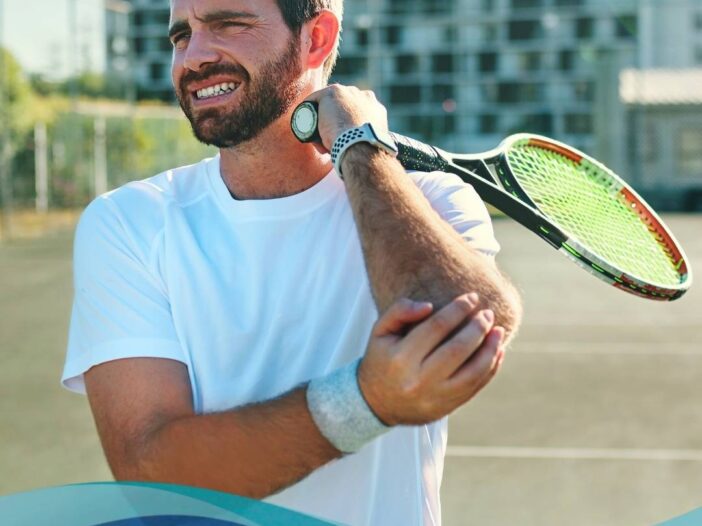
Tennis elbow is caused by inflammation or damage and partial tearing in the tendons of the forearm muscles where they attach to the bone at your elbow. This results in pain around the outside of your elbow and often tenderness and swelling and forearm pain. You may experience difficulty in straightening your arm, gripping objects (like a tennis racquet) or moving your wrist.
Can I treat tennis elbow at home?
Tennis elbow can be effectively managed by stopping whatever activities make it painful and resting your elbow joint. Ice packs plus paracetamol or anti-inflammatory gel can help ease the pain and swelling. Over the counter supports can help you, along with simple exercises to gently move the joint and stretch the tendons affected.
If your tennis elbow does not improve with two weeks, contact us for a consultation and rapid diagnosis (as your pain may be caused by something other than tennis elbow). Our orthopaedic consultants will assess your injury and put together a treatment plan for your individual needs. This may include specific exercises, physiotherapy and other non-surgical treatments (less than 10% of all our patients require surgery).
Stimulating healing in your elbow
Our consultants may also recommend “biological stimulation” which includes treatments such as:
- Needle barbotage (dry needling)
- Shockwave treatment
- Platelet rich plasma injections (PRP)
These treatments work by stimulating your body to heal itself more effectively and do not involve drugs or pharmaceuticals.
Can’t I just have a steroid injection like I always do?
This is a question we are asked all the time. Whilst we are tempted to say “why are you looking for another injection as it wasn’t effective last time?”, we much prefer that a highly experienced orthopaedic consultant looks at your elbow and assesses the best treatment for your condition.
Our consultants may offer a cortisone injection in very rare circumstances. However, current best evidence does not support cortisone injections for tennis elbow. Our consultants find that often the pain returns after a few months if the injection is not accompanied by a modification in activity and a structured exercise programme to rehabilitate and strengthen the tendons.
Surgery is a final option when all other treatments do not resolve your issue. Your consultant will discuss this with you at your consultation if and when required.
Private consultations within days, not months
Call us to book your private consultation with a Joint Reaction specialist orthopaedic surgeon from as little as £300. No private medical insurance or GP referral required.
ABOUT THE AUTHOR
This article was co-written with expert insight and advice by Joint Reaction Consultant Orthopaedic Surgeon Ankit Desai BSc MBBS FRCS (Tr & Orth).
IMPORTANT: This article on tennis elbow is for your information only. It is not intended as a substitute for professional medical advice or diagnosis. When you first meet your Joint Reaction consultant, they will discuss any issues, previous diagnosis or scans you may have.
Article published: September 2026.
—//—
SOURCES:
(1) https://www.usopen.org/en_US/news/articles/2026-08-26/serena_and_venus_williams_receive_2026_us_open_doubles_wild_card.html